
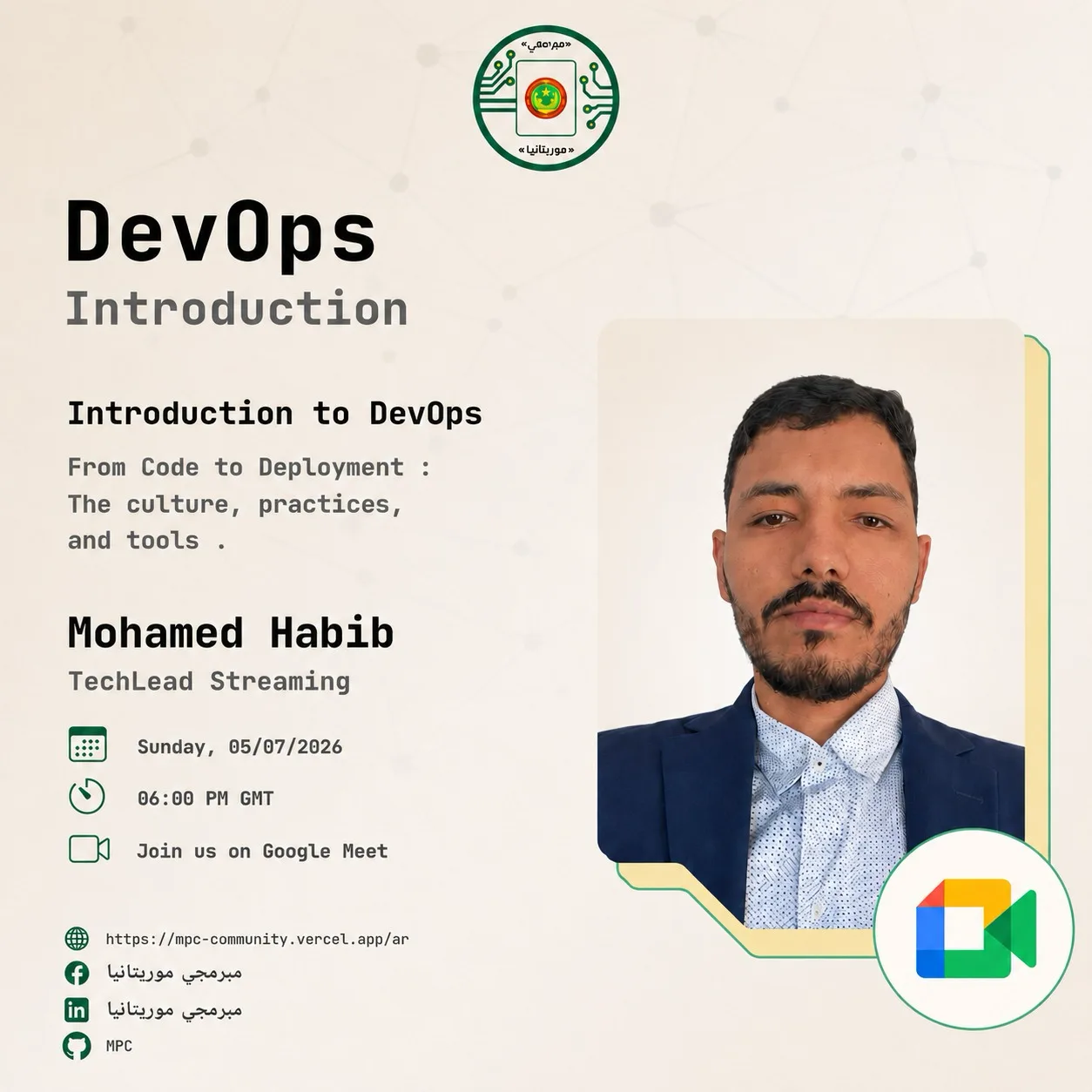
Introduction to DevOps - From Code to Deployment
We're back! The Mauritanian Programmers Community (MPC) restarted its technical sessions with one of the most essential disciplines in modern software engineering: DevOps.
Our sincere thanks go to Mohamed Habib, Streaming Tech Lead, for delivering an outstanding beginner-friendly introduction to the culture, practices, and tools that power today's software delivery pipelines. He walked the community through the full journey a single line of code takes from a developer's laptop to production.
Beyond the Buzzword
The session opened with the world DevOps was born to fix: the 2000s, where developers threw code "over the wall" to operations, waterfall releases took months before a single user touched a feature, and "it works on my machine" was a nightly ritual. DevOps is the answer to that pain. It is not a job title or a stack of tools, but a culture that tears down the wall between Development and Operations.
What We Covered
- What DevOps really is: why it matters beyond the hype.
- The evolution: from waterfall and manual, high-stress releases to continuous flow.
- The DevOps lifecycle: collaboration between Development and Operations.
- Version control: Git and GitHub as the single source of truth.
- Continuous Integration and Delivery (CI/CD): build, test, and ship on every commit.
- Containerization with Docker: package the app with its environment, so dev = test = prod.
- Kubernetes: running containers at scale with self-healing, desired-state orchestration.
- Cloud computing fundamentals: the infrastructure that powers modern delivery.
- Infrastructure as Code (IaC): managing servers with Terraform, reviewed and versioned like code.
- GitOps: the cluster pulls its own desired state from Git (Argo CD), and drift is auto-corrected.
- Monitoring and observability: metrics, logs, and traces (Prometheus, Grafana) to debug distributed systems.
- DevSecOps: shifting security left, into every stage of the pipeline instead of a final audit.
- The learning roadmap: where to start with DevOps and where the career paths lead.
It's a Culture, Not Just Tools
The most important takeaway: DevOps is not simply a collection of tools. It rests on the CALMS pillars: Culture, Automation, Lean, Measurement, and Sharing. Tools enable the culture. They never replace it. Collaboration, automation, continuous learning, and continuous improvement are what actually move a team from "one nervous release a quarter" to "commit to production in minutes, every step audited."
Why it Mattered
This wasn't a theoretical lecture. Mohamed walked the community through the real problems each tool was invented to solve, drawing on hands-on industry experience to make an intimidating field feel approachable for students, professionals, and self-taught developers alike.
Conclusion
We extend our heartfelt appreciation to Mohamed Habib for volunteering his time and sharing his valuable experience with our community. A big thank you as well to everyone who attended, asked thoughtful questions, and contributed to the discussion.
Missed the session? The recording and slide deck are linked at the top of this page. Stay tuned for more technical sessions!